
What is this blog about?
- Explores tools that strengthen a B2B digital marketing plan, from account targeting to revenue attribution.
- Covers SEO, automation, website personalisation, hyper-personalisation, and AI-powered engagement.
Who should read it?
- B2B marketers and demand generation teams.
- Business leaders focused on pipeline growth and revenue.
Why is this important knowledge?
The right tools solve specific marketing challenges and improve campaign performance.
What can you do with this insight?
- Identify gaps in your marketing process.
- Choose tools to target, engage, and convert relevant buyers.
- Measure marketing’s impact on pipeline and revenue.
In the previous article, we explored why B2B campaigns fail before launch and what it takes to create a more effective B2B digital marketing strategy. Now, building up on our previous discussion, we will dive deep into the exact tools you need to take your B2B digital marketing plan to the next level.
Modern B2B teams have access to tools that can:
- Identify accounts showing buying signals
- Enrich account data and automate workflows
- Capture high-intent search opportunities
- Identify website visitors showing buying intent
- Build interactive tools for buyer engagement and qualification
- Personalise website experiences based on account context
- Enable self-guided product demonstrations
- Use AI for qualification and faster responses
- Deliver hyper-personalised customer experiences
- Connect marketing activity to pipeline and revenue
However, access to these tools doesn’t automatically create a better marketing engine.
The real value comes from knowing which tool solves which problem, what data it needs, and what action should follow the signal it produces. Explore the strategies and tools below for effective digital marketing for b2b business.
Start with Intent-Driven Account Targeting
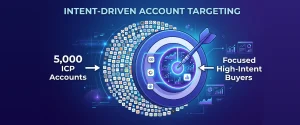
Your ICP tells you which accounts fit your target market. Intent data shows which of those accounts are actively researching topics related to your product or category.
For example, having 5,000 companies that match your ICP does not mean all 5,000 are ready to buy. A smaller group may already be showing signs of active interest.
Sales and marketing teams can use intent data to focus on accounts that are actively researching a solution and may be closer to making a purchase.
We have listed below some of the best b2b marketing tools to support this process.
The Tools
-
6sense (Paid, Custom Pricing)
6sense helps businesses identify accounts that are actively researching topics related to their solutions. Its intent model uses activity from CRM, MAP, web, B2B network keywords, and third-party intent sources.(1)
Teams can use this intent data to identify ICP-fit accounts that are actively researching relevant topics.
This makes 6sense useful for ABM teams that want to identify potential buyers and engage them at the right stage. You may use it in your B2B digital marketing plan to help connect buyer research with campaign decisions and sales action.
Particularly useful for the human side of account intelligence, LinkedIn Sales Navigator allows teams to search for accounts and leads using criteria such as company characteristics and roles.
LinkedIn says Sales Navigator Buyer Intent uses more than 180 distinct insight signals to produce its aggregated Buyer Intent Score.(2) These can include company-page engagement, advertising engagement, profile activity, and website visits where the relevant LinkedIn technology is installed.
The insights help teams identify relevant stakeholders and prioritise accounts showing meaningful buying interest, which makes your B2B digital marketing plan more impactful.
-
Bombora (Paid)
It analyses content consumption across the web and classifies it into business topics. Bombora’s Company Surge Intent data identifies businesses showing increased research activity around specific topics.(3)
It is recommended that you select topics based on your products, industry, competitors and buyer challenges. These topics help teams understand what target accounts are researching and identify businesses showing increased research activity.
Turn Signals Into Action with Enrichment and Workflow Automation
Intent data only matters when teams can act on it. If an account suddenly researches a relevant topic, you need more context:
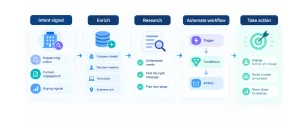
- who the company is,
- which business unit matters,
- who the decision-makers are,
- what technology it uses,
- and who owns the account.
You also need to decide what message to send and whether marketing or sales should act first. This is where enrichment and orchestration tools help in your B2B digital marketing plan.
The Tools
-
Clay (Free + Paid)
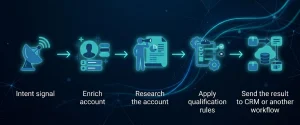
Clay combines data enrichment with workflow automation. Its enrichment tools add information to company and contact records, while Workflows connect triggers, conditions and actions. Clay specifically lists inbound lead qualification and routing and signal-based outbound as workflow use cases.(4)
Clay also supports Custom Signals and scheduled enrichment. Custom Signals can monitor websites, social platforms and other sources for changes, while scheduled enrichments can keep company data updated over time.
-
Apollo (Free + Paid)
It provides Contact & Account Search, Lead Scoring & Signals, Sales Engagement, and Enrich & Cleanse. Apollo’s database lets users find leads and companies using 65+ filters. Apollo also supports buying intent data, CRM enrichment, CSV enrichment, and API enrichment.(5)
Teams can use its signals to identify relevant prospects and its sales engagement tools to run outreach sequences. This allows you to get ahead with a more strategic B2B digital marketing plan.
-
Findymail (Paid Plans + Free Trial)
Ideal for email finding and verification within prospecting workflows, Findymail becomes particularly useful when a campaign starts from a signal or account list.
It helps teams find and verify professional email addresses, making it easier to identify the right contacts and move from account research to targeted outreach.
Capture High-Intent Demand with Bottom-Funnel SEO
Traditional content strategies often focus heavily on informational keywords.
That creates reach, but it does not necessarily capture buyers who are evaluating solutions.
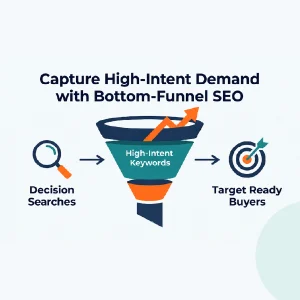
A more commercially focused SEO strategy also looks for searches such as:
- [Product] alternatives
- [Product] vs [Product]
- Best [category] software
- [Category] pricing
- [Category] implementation
- [Category] migration
- [Product] competitors
- [Product] for [industry]
These searches can reveal a much more specific problem: the buyer is trying to make a decision.
The Tools
-
Ahrefs (Paid Plans + Free Tools)
Ahrefs can help uncover competitor keyword coverage, search demand, and content gaps.
Its Content Gap functionality is particularly useful for finding keywords for which competing websites rank, but your website does not. That gives marketers a starting point for identifying missing search opportunities.
The goal is not simply to find a keyword and write an article. First, understand the search intent and buying stage, then create the right page for that need.
For example, a comparison page should not be treated like a generic educational blog post.
The reader is asking a decision question. So, the page should answer it directly.
-
Semrush (Free + Paid)
Providing keyword research, competitor analysis, and SEO research capabilities, Semrush becomes more useful when paired with Google Search Console. Search Console shows the queries already bringing impressions and clicks to your site, and Semrush gives you a broader view of the search landscape.
Together, they reveal both existing demand and new opportunities.
-
Clearscope (Paid Plans + 14-Day Free Trial)
This tool can support both content planning and content optimisation, from identifying topics and search intent to refining content against top-ranking results.
Clearscope can help refine content around search intent and relevant topics. However, the buyer’s problem should still guide what you create.
-
Webflow (Free + Paid)
Webflow lets marketers build and publish landing pages without relying on developers for every change. Its page-building tools help teams create campaign and SEO pages faster using templates and approved components.
This can reduce bottlenecks when marketing teams need to launch and update multiple pages.
Turn Website Traffic Into Identifiable Buying Signals
A website is not just a destination; it is a source of behavioural information.
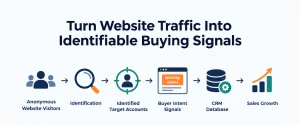
The challenge is that many B2B visitors do not complete a form.
Visitor-identification tools can provide additional context about accounts visiting a site, subject to their data availability, privacy practices, and applicable regulations.
The Tools
-
Warmly (Paid)
Warmly identifies website visitors and routes relevant activity into sales workflows. Teams can combine visitor behaviour with account fit to prioritise stronger buying signals.(6)
For example, an ICP account visiting a pricing page can be prioritised over an anonymous homepage visit. Qualifying activity can then be routed to sales.
-
HubSpot (Free + Paid)
Another tool that can be a holy grail for your B2B digital marketing plan is HubSpot. It connects website activity with CRM records.(7) Forms can create or update contacts, while activities such as form submissions can appear on their records. Lifecycle stages can also be updated as contacts move through the marketing and sales process.
This gives teams a clearer view of each contact’s activity and where they are in the buying journey.
Build Interactive Assets Instead of Relying Only on Gated PDFs
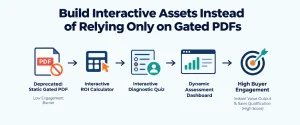
Interactive tools can ask for inputs, produce an output, and create a natural reason for a follow-up conversation.
The Tools
-
Outgrow (Paid Plans)
Outgrow supports interactive experiences such as calculators, quizzes, and assessments.(8)
A B2B company could use it to build:
- ROI calculators
- Savings estimators
- Readiness assessments
- Maturity assessments
- Product recommendation experiences
The quality of the result depends on the underlying methodology.
-
Typeform (Free Trial + Paid)
This tool supports interactive forms, questionnaires and lead-capture experiences.
Typeform is particularly useful for structured qualification or diagnostic experiences where the questions themselves are part of the buyer journey.
Personalise the Website Based on Account Context
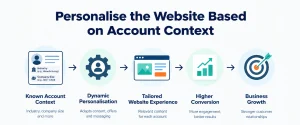
Different buyers visit your website looking for different things. A manufacturing company may want to understand operational efficiency, while a technology company may be more interested in integration capabilities.
Website personalisation helps businesses tailor content to relevant audience segments using available customer and account data.
The Tools
-
HubSpot (Free + Paid)
HubSpot allows businesses to connect website activity with CRM contact records and use available CRM data to personalise supported digital experiences.
This helps marketing teams align website content with known contacts and keep their marketing activities connected to the buyer journey.
Give Buyers a Self-Guided Product Experience
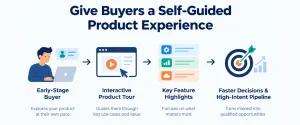
For complex B2B products, a static screenshot often does not provide enough context.
Interactive demos allow prospects to explore specific workflows themselves.
The Tools
Navattic enables companies to create interactive product demonstrations.(9)
Instead of asking a prospect to book a call simply to understand how a workflow looks, you can give them a controlled self-guided experience.
The strongest use is not: “Take a tour of our product.”
It is: “See how this specific workflow works.”
This distinction keeps the demo aligned with the buyer’s problem.
-
Storylane (Free + Paid)
Storylane offers interactive product demo capabilities that can similarly support self-guided product exploration.(10)
These tools become particularly useful for sales and marketing teams that need to demonstrate software repeatedly without scheduling a live session for every early-stage prospect.
Use AI for Qualification and Response Speed
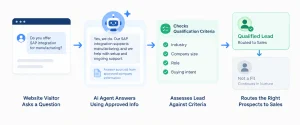
AI can now handle parts of the initial buyer interaction.
But this works best when the business already knows what a qualified conversation looks like.
The Tools
-
Qualified (Paid, Custom Pricing)
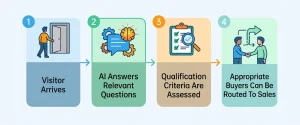
This highly effective tool positions its AI agents around website engagement, qualification, and meeting booking.
The business needs to define the qualification rules first.
Otherwise, the AI simply creates more conversations without necessarily creating better opportunities.
-
Chatbase (Free + Paid)
Chatbase can be used to build AI agents trained around a company’s content and knowledge base.
It is useful for handling product questions, documentation queries, and initial qualification.
The important safeguard is source control.
An AI agent should answer from approved information and have clear boundaries for when it should say it does not know.
Use Hyper-Personalisation to Deliver More Relevant Experiences
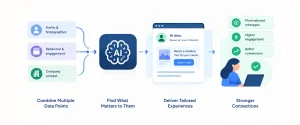
Hyper-personalisation uses customer data and behaviour to tailor marketing messages to individual needs. Instead of sending the same offer to everyone, businesses can adapt recommendations, messages and follow-ups based on what customers actually do.
The Tools
-
Adobe Real-Time CDP (Paid, Custom Pricing)
Adobe Real-Time CDP combines customer data from different sources to build unified profiles and create targeted audience segments. This helps marketing teams deliver more relevant experiences based on customers’ available data and interactions.(11)
-
Optimove (Paid)
Another cutting-edge tool for hyper-personalisation, Optimove uses customer data and segmentation to help marketers identify customer groups and tailor campaigns to their behaviour. This can help teams decide which message or campaign is more relevant to different customer segments.(12)
The goal is simple: use what you know about your customers to deliver more relevant messages, recommendations and follow-ups instead of relying on the same campaign for everyone.
Connect Marketing Activity to Pipeline
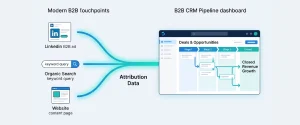
Marketing needs to show which campaigns are turning leads into customers and generating revenue. Tracking leads from the first campaign interaction to the final sale helps businesses understand which campaigns are contributing to revenue.
The Tools
-
HubSpot (Free + Paid)
Its attribution reports show which marketing interactions receive credit for generating contacts, creating deals and contributing to revenue.
Available reports and attribution models depend on the subscription.
-
Salesforce (Free Options/Trials + Paid)
Salesforce is particularly important when sales opportunities and pipeline data are already managed within the platform.
The goal is to connect marketing activity with the same opportunity records that sales leadership uses to evaluate pipeline.
-
Dreamdata (Free + Paid)
Focused specifically on B2B revenue attribution and analytics, Dreamdata becomes more relevant in your B2B digital marketing plan as the buying journey becomes more complex and involves multiple contacts, channels, and interactions.
Final Word
The right tools can make your B2B digital marketing plan more effective, but only when they solve real problems. Start by identifying where your current process falls short. Then choose tools that help you reach the right buyers, capture demand and measure results. The goal is not to use more tools. It is to turn marketing activity into meaningful business outcomes.
Explore our digital marketing services to find the right approach for your business.
FAQs

Which B2B marketing platform is the best?
The best B2B marketing platform depends on your goals and B2B digital marketing plan. HubSpot suits teams looking to connect marketing and CRM activities. On the other hand, Salesforce supports broader sales and marketing operations. Furthermore, tools such as 6sense and Apollo help with account targeting and prospecting.
What is the best CRM for B2B?
There is no single best CRM for every B2B business. HubSpot, Salesforce, Microsoft Dynamics 365 and Zoho CRM are worth considering. Compare their features and pricing before choosing the right one for your B2B digital marketing plan.
What are the top 5 CRM tools?
Five CRM tools worth evaluating for B2B businesses are:
- Salesforce
- HubSpot
- Microsoft Dynamics 365
- Zoho CRM
- Pipedrive
The right choice depends on your sales process, marketing needs, budget, integration requirements, and your overall B2B digital marketing plan.
What are the 7 P's of B2B marketing?
The 7 Ps are:
- Product
- Price
- Place
- Promotion
- People
- Process
- Physical Evidence
They help businesses shape their offering, pricing, distribution, communication and customer experience.
What is the 3-3-3 rule for marketing?
The 3-3-3 rule has no universal definition. However, one practical marketing framework recommends focusing on three core messages, three target audience segments, and three marketing channels to keep campaigns focused and resources well allocated.