
A B2B campaign can have a strong creative concept and a healthy media budget, yet still produce disappointing results. The problem often starts much earlier in executing a B2B digital marketing strategy.
Here’s the blunder: you launch a campaign before the business is clear on who it wants to influence, what problem it solves, and where the audience is in the buying journey.
Without a clear value proposition and next step, even a well-executed campaign can struggle to deliver results.
That is why a strong B2B digital marketing strategy is less about choosing channels and more about making the right decisions before execution begins.
Recent B2B research makes this especially important. Buyers increasingly research independently, use multiple channels, and form preferences before speaking with sales. Reportedly, buyers use an average of 10 channels throughout the purchasing journey.(1)
So, where do campaigns go wrong? Let’s discuss!
The Campaign Starts Before the Campaign
Treating campaign planning as a production exercise is a common mistake in digital marketing for B2B.
If your team is focusing on creating assets and launching campaigns before defining the strategy, you are setting yourself up for failure.
You need to define the following before execution begins:
- Business goal
- Target accounts
- Buyer needs
- Value proposition
- Channels and measurement
The implication is straightforward: a campaign cannot compensate for a poorly designed buying experience.
Below, we have defined why a campaign can fail before it launches and what B2B digital marketing strategy you should follow instead.
-
The Audience Is Too Broad
Let’s start with the first problem: your audience is too broad. A useful digital marketing strategy for B2B business needs to precisely define the following.
| Dimension | Strategic question |
| Company | Which types of organisations are commercially relevant? |
| Account | Which companies deserve priority? |
| Role | Who influences, approves or uses the solution? |
| Problem | What business issue are they trying to resolve? |
| Trigger | What event could create urgency? |
| Buying stage | Are they researching, comparing or ready to engage? |
| Value | What measurable business outcome matters to them? |
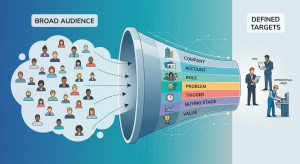
This becomes particularly important when campaigns target complex purchases. Reportedly, B2B buying groups average more than 10 people, and buyers typically evaluate several vendors during the process.(2)
A campaign aimed at a CFO should therefore not automatically look or sound like one aimed at an operational user, even when both influence the same purchase.
-
The Message Is Built Around the Product
Another frequent problem is starting with the company’s offering.
Statements like “We provide cloud ERP” or “We offer cybersecurity solutions” describe the business. However, they do not necessarily explain why a buyer should pay attention.
One’s approach should start with the commercial consequence. It has to be clarified what expensive, urgent or strategically important problem we are helping this buyer address.

This is where customer research becomes valuable. According to industry reports, 29% of B2B marketers with moderately effective or less effective content strategies identified ineffective audience research as a contributing challenge.(3)
Before writing campaign copy, understand the language buyers actually use to describe the problem.
Look at:
- Sales call notes
- Customer interviews
- Lost-deal reasons
- Support questions
- Search behaviour
- Procurement objections
- Competitor comparisons
- Questions raised during demos
That material usually produces stronger campaign messaging than a brainstorming session around product features.
-
The Campaign Targets Buyers Too Late
Usually, b2b lead generation is treated as the beginning of the B2B funnel.
For many buyers, it is closer to the middle.
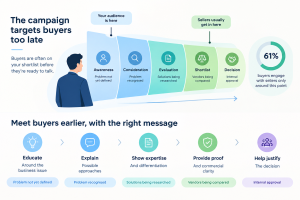
As per industry reports, 95% of the time, the winning vendor is already on the buyer’s shortlist from the start. Buyers typically engage with sellers only after reaching around 61% of the way through their purchasing journey.(2)
This changes how digital marketing for B2B businesses should be planned.
If marketing appears only when a buyer is ready to submit a form, competitors may already have influenced the evaluation.
A mature B2B digital marketing strategy therefore needs content and distribution that establish familiarity before an active sales opportunity exists.
|
Buying situation |
Useful marketing role |
| Problem not yet defined | Educate around the business issue |
| Problem recognised | Explain possible approaches |
| Solutions being researched | Demonstrate expertise and differentiation |
| Vendors being compared | Provide proof, evidence and commercial clarity |
| Internal approval | Help buyers justify the decision |
The objective is not to force every visitor into a sales conversation; it is to make the company easier to consider when the buying process begins.
-
Every Channel Gets the Same Message
A campaign may run across LinkedIn, Google, email, webinars, content, retargeting and the company website. However, there is one thing you should keep in mind.
If every channel simply repeats the same headline, the business is distributing content. It is not necessarily designing a connected buyer experience.
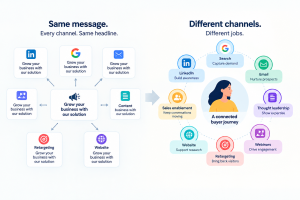
B2B buyers now move between digital, remote, and in-person interactions. This is an established omnichannel pattern rather than an occasional preference.(4)
Each channel should have a defined job.
For example:
- Search: capture existing demand.
- LinkedIn: build awareness within relevant professional audiences.
- Email: develop known prospects.
- Thought leadership: establish expertise.
- Webinars: deepen engagement around a defined problem.
- Retargeting: bring previous visitors back into the consideration process.
- Sales enablement: help sellers continue conversations with relevant evidence.
The mistake is measuring every channel against the same immediate conversion target.
-
The Content Plan Is Driven by Volume
Publishing more content does not automatically create more demand.

Reportedly, only 29% of marketers with a documented content strategy consider it extremely or very effective. Among those reporting weaker performance, 20% cite a focus on content quantity over quality.(3)
For a serious B2B digital marketing strategy, the question should be:
What information could materially change the buyer’s understanding of the problem or decision?
That might mean:
- A detailed comparison
- An implementation guide
- An ROI framework
- A technical explainer
- A buyer checklist
- A customer case study
- A procurement guide
- An industry-specific analysis
The format matters less than the usefulness of the information.
-
Marketing Measures Leads Instead of Business Progress
Your campaign can generate 5,000 clicks, but still contribute little commercially.
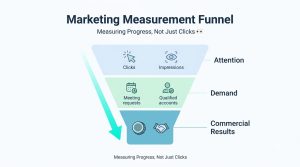
The reverse can also happen. A campaign may generate fewer leads while reaching accounts that are genuinely valuable.
Hence, campaign measurement should extend beyond:
Impressions → Clicks → Leads
This is what a stronger measurement structure might look like:
| Level | Metrics |
| Attention |
|
| Engagement |
|
| Demand |
|
| Sales |
|
| Commercial |
|
| Efficiency |
|
The exact metrics should depend on the business model and sales process. Furthermore, the measurement should connect marketing activity to commercial outcomes.
-
Sales Enters After the Campaign Launches
This is one of the most expensive planning mistakes.
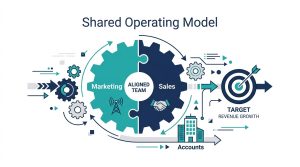
Sales teams often know which accounts matter, which prospects are already engaged, which objections repeatedly appear, and which opportunities are strategically important.
Leaving that knowledge outside the campaign planning process creates unnecessary distance between marketing activity and commercial reality.
Before launch, the B2B digital marketing strategy should establish:
- Which accounts are priorities,
- Which contacts matter within those accounts,
- What signals indicate meaningful interest,
- When marketing should involve sales,
- What information sales receives, and
- What follow-up experience the prospect gets.
That creates a shared operating model rather than a handoff from one department to another.
A Better Pre-Launch Framework
Before approving a B2B campaign, senior marketers should have clarity on the following:
Audience: The specific audience the campaign aims to influence.
Problem: The business problem that makes the campaign relevant.
Timing: The reason the buyer would care now.
Positioning: Why the buyer should consider the company.
Evidence: The proof that supports the campaign’s claims.
Journey: The next step the buyer should take after the first interaction.
Channels: The channels that will support each stage of the buyer journey.
Sales: The role sales will play in the campaign.
Measurement: The commercial outcomes that will determine success.
If several of these areas are unclear in your B2B digital marketing strategy, the campaign is probably not ready.
What’s Next
A strong B2B digital marketing strategy needs the right tools to turn planning into execution. In our next, more detailed blog, we will explore the exact tools you can use for audience research, buyer intent, content planning, campaign execution, measurement, and more.
Stay tuned as we break down the tools that can help you build and manage a stronger B2B marketing strategy.
Final Word
Strong B2B campaigns are built on clear strategic decisions before execution begins. When audience, positioning, content, channels, sales involvement, and measurement are aligned upfront, campaigns have a stronger foundation for commercial results. A well-planned strategy turns execution into a strategic process.
Looking to build a stronger B2B digital marketing strategy? Explore our digital marketing services to create campaigns built around your business goals.
FAQs

What are B2B marketing strategies?
B2B marketing strategies are planned approaches businesses use to reach and influence other businesses throughout the buying journey. They include:
- Content marketing
- SEO
- Demand generation
- Account-based marketing
- Events and paid campaigns
- Depending on the audience
- Goals
- Buying process
What is the rule of 7 in B2B?
The Rule of 7 in B2B marketing is the idea that a potential client needs to interact with a brand at least seven times before making a purchase decision. It highlights the importance of consistent, relevant touchpoints across channels.
What are the 7 main reasons why products fail?
Products commonly fail because they:
- Solve a weak or unclear problem
- Target the wrong market
- Lack differentiation
- Are priced poorly
- Offer a weak customer experience
- Launch at the wrong time
- Struggle with marketing and distribution
These issues can prevent even a well-designed product from gaining meaningful market adoption.
What are the four C's of B2B marketing?
The four Cs are Customer, Cost, Convenience, and Communication. The framework looks at marketing from the buyer’s perspective:
- Understanding their needs
- Considering the total cost
- Making the buying process easier
- Communicating in a clear, relevant way
What are the 7 steps of marketing strategy?
The seven steps are:
- Setting goals
- Researching the market
- Defining the target audience
- Analysing competitors
- Developing positioning and messaging
- Choosing channels and tactics
- Measuring and refining performance.
Together, these steps create a clear plan for reaching the right audience and supporting broader business goals.