What is this blog about?
- Why B2B teams are moving from attendance-based event metrics to Event Demand Generation, treating events as a connected stage in the revenue funnel rather than a standalone activity
- The event conversion funnel, audience acquisition, intent data, post-event follow-up, and ROI measurement across the event lifecycle
Who should read it?
- CMOs, marketing heads, and demand generation managers
- Event managers and channel/partner marketing leaders
- SaaS companies, OEMs, and enterprise marketers running multi-event calendars
Why is this important?
- Attendance and booth traffic are increasingly disconnected from pipeline: 98% of organisations struggle to justify event spend to leadership, and 86% can’t accurately attribute ROI. Measurement, not execution, is now the bottleneck
What can you do with this insight?
- Redefine event success around pipeline, SQLs, and revenue influence, not footfall
- Connect audience acquisition, engagement, and follow-up into one funnel with an ROI scorecard that predicts revenue instead of counting attendees
According to Vendelux’s 2026 B2B Events Survey of 120+ marketing and events leaders found 39% call events their ‘most important revenue channel,’ while 44% call them ‘influential for pipeline but hard to measure.’ Event Demand Generation closes that gap, treating the event as one stage in a connected revenue process instead of a one-day activity with its own siloed budget. The broader B2B demand generation services market reflects the shift, valued at $8.75 billion in 2025 and projected to reach $21.84 billion by 2034, a 10.70% CAGR.
Why Event Success Needs A New Definition
This isn’t a case against b2b events. 78% of organisers still call in-person conferences their most impactful marketing channel, and 71% of attendees say in-person B2B conferences are the most effective way to learn about new products. The channel isn’t the problem, the scoreboard is.
For years, event success was measured by what’s easiest to count: attendance and registration numbers, booth visits, badge scans, speaker session ratings. None of it says whether the event actually moved revenue. Leading organisations have shifted to a different scorecard, one built around pipeline and SQL generation, metrics that tie the event back to what it was actually meant to do.
Benchmark Data Point: Forrester puts the average B2B buying committee at 13 stakeholders; Gartner’s 2025 research puts the range at 9-11 for typical purchases, rising to 25 for enterprise deals. A single badge scan was never going to represent that many decision-makers.
What Is Event Demand Generation?
- Events stop being isolated, one-day activities with their own siloed budget and KPIs
- The event becomes one stage in a connected process: audience acquisition before, structured engagement during, disciplined follow-up after
- Success is measured by what the event contributes to pipeline, extending beyond the room
- Cvent frames this as ‘Event-Led Growth,’ using events as a core, repeatable channel for audience acquisition and retention rather than one-off activities
| Traditional Event Marketing | Event Demand Generation |
| Success = attendance and registrations | Success = pipeline and revenue influence |
| Audience acquisition is an afterthought | Audience acquisition starts months out, with ICP (Ideal Customer Profile) targeting |
| Engagement tracked by booth traffic | Engagement tracked by intent signals and lead scoring |
| Follow-up = generic post-event email | Follow-up = personalised outreach within 24 hours |
| ROI = cost per attendee | ROI = pipeline generated per dollar of event spend |
The 2026 Numbers Behind the Shift
- Event budgets are split almost evenly. 40% of organisers expect growth, 40% expect flat budgets, and 20% expect a decrease, while 45% of event teams operate with just 1–3 people
- 40% of organisers still report difficulty proving event ROI in 2026, down from 70% in 2025, but still a meaningful gap
Why Events Are The Most Valuable First-Party Data Source
As third-party cookies disappear and AI search summaries answer questions without driving clicks to a website, digital attribution is getting harder across most channels, making events one of the few remaining sources of first-party data a business actually owns.
Every one of these is a buyer intent signal:
- Registration and form fields completed
- Sessions attended and time spent
- Questions asked, polls answered
- Content downloaded
- Networking interactions on-site
Benchmark Data Point: 52% of marketers attribute at least half their closed-won deals to events, and event-sourced leads convert to opportunity at a 40% rate, a return that only happens when these signals are captured and acted on with urgency.
The Event Marketing Conversion Funnel
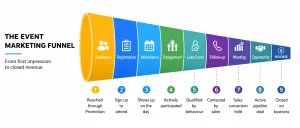
Where organisations typically lose leads:
- Top of funnel: the wrong audience enters because acquisition wasn’t ICP-filtered
- Engagement: attendees show up but aren’t scored or segmented on-site, and messaging stays generic
- Follow-up: interest is captured but never converted into a next step
Audience Acquisition Determines Success Long Before Event Day
No agenda fixes a room full of the wrong people. The work that happens months before the event:
- Targeted digital campaigns and LinkedIn outreach
- Database marketing and partner outreach
- Tele-calling to warm and qualify registrants
- EDMs and remarketing to people showing early intent
What actually predicts event success:
- The percentage of attendees who match your ICP
- Cross-referencing the registration list against CRM event data, filtered by job title and company size
- Pre-populated fields and conditional questions convert at 24.4%, more than double the 11.6% rate of static forms, leading to dynamic registration flows
This is why exclusivity is gaining ground in 2026: a broad trade show floor builds awareness in a new market, while a smaller invite-only executive dinner or customer roundtable deepens existing accounts. Inviting a respected customer to co-present, a brand advocate rather than a salesperson, often does more for credibility than another vendor pitch. Ten highly engaged, ICP-fit attendees will consistently outperform a packed room with shallow interactions.
From Strategy To Execution: A Multi-City Case Study
Operational discipline is what actually makes a multi-city calendar repeatable. Channel Technologies saw this firsthand when a global technology firm asked it to run back-to-back Security, AI, and Sustainability training sessions across Delhi and Mumbai inside a single 48-hour window.
Rather than force one plan across two cities, the team built city-specific playbooks, ran venue dry-runs ahead of time, and layered in rain-contingency buffers for Mumbai’s monsoon-season logistics. The result:177 attendees in Delhi and 85 in Mumbai, each spending upward of two hours in session, with a brand and learning experience that felt identical in both cities. This is a useful reminder that the gap between a repeatable event channel and a one-off scramble usually comes down to execution, not strategy. You can access the full Case Study on our site, linked here: A Multi-City Event Execution.
How AI Is Transforming Event Demand Generation
AI performs best embedded into an existing, disciplined process, without working as a direct replacement.
- AI-assisted lead scoring that ranks intent in real time
- Personalised your event journeys and session recommendations based on registration data
- Automated, context-aware post-event follow-up in place of generic blast emails
- Generative tools drafting first passes of analytics reports, event marketing communications, and agenda and content design
Benchmark Data Point: 95% of event organisers expect their use of AI in events to increase, and 66% of event professionals already say AI frees up time for higher-value work rather than replacing it. The same research flags accuracy and governance as open concerns, which is the right instinct.
Why Post-Event Engagement Matters
72% of marketers say prospects close deals faster after attending an event, and 31% report a 20-30+ day decrease in sales cycle for event-sourced deals – an advantage that disappears without a disciplined handoff.
What a tight post-event handoff looks like:
- Same-day notes: every meaningful conversation logged to keep track
- Lead tiering within 24 hours: segmented by intent, active evaluators, future prospects
- Personalised outreach, not blast email: referencing the actual conversation, not a generic ‘great to meet you’
- Sales-to-marketing alignment defined before the event: who owns follow-up for each tier, and what’s the SLA
- CRM hygiene: every contact logged, tagged with event source, with context notes attached
- A team debrief within a week: reviewing what worked and what to change next time
The shift underway across event and marketing agencies is really a shift in what ‘success’ means: from ‘did the event run smoothly’ to ‘what pipeline did it produce.’ Agencies winning long-term relationships build event strategy, acquisition, execution, and follow-up as one connected engine.
Conclusion
Outdated measurement leaves high-intent attendees without follow-up, buying committees reduced to a single badge scan, and deals stalling because sales and marketing work from two different versions of the same event. The organisations that win from here won’t be the ones running the most events. They’ll be the ones treating events as long-term growth platforms, measured by revenue influence, not footfall.
Whether you’re planning a corporate event, launching a demand generation campaign, or building an integrated B2B marketing strategy, Channel Technologies can help you create impactful experiences that generate qualified leads and real business outcomes.
FAQs:

What does Event Demand Generation improve over traditional event marketing?
The accuracy of success itself, tracking pipeline influence, ICP fit, and revenue attribution instead of just attendance.
How is event ROI different from these metrics?
ROI is usually a cost calculation; Event Demand Generation tracks pipeline generated and deals genuinely influenced by the event.
Why does the conversion funnel matter?
Most lead loss happens at predictable points - acquisition, engagement, or follow-up, and the funnel makes those leaks visible.
Why does post-event engagement matter more than the event itself?
Intent decays fast; same-day notes and fast, personalised outreach convert interest into pipeline before it cools.
Are most B2B teams already measuring events this way?
Not yet: 98% call justifying event spend a struggle, and 86% can't accurately attribute ROI.