What is this blog about?
- Explores the hidden costs of selling without buyer intent and why traditional cold outreach is becoming less effective in modern ERP lead generation and B2B sales.
- Explains how buyer intent data, sales intelligence, and AI help ERP providers improve ERP lead generation by identifying high-intent prospects, prioritize accounts, and personalizing outreach.
- Compares leading buyer intent and sales intelligence platforms, including Apollo.io, Cognism, Bombora, 6sense, Demand base, and other tools that support data-driven ERP lead generation strategies.
Who should read it?
- ERP solution providers and B2B software companies looking to strengthen their ERP lead generation efforts.
- BPO Heads, Sales Directors, and Business Development Managers
- Demand generation and marketing teams
- Revenue Operations (RevOps) professionals
- Business leaders looking to improve lead quality, shorten sales cycles, and increase conversion rates
Why is this important knowledge?
- Traditional prospecting methods often rely on static contact lists and cold outreach, leading to low engagement, higher customer acquisition costs, and longer sales cycles, making ERP lead generation increasingly inefficient.
- Buyer intent data helps organizations identify companies actively researching ERP solutions, enabling sales and marketing teams to focus on high-value opportunities and improve pipeline efficiency.
What can you do with this insight?
- Identify and prioritize high-intent ERP prospects before competitors do.
- Combine buyer intent with sales intelligence to improve lead qualification and personalized outreach within your ERP lead generation strategy.
- Select the right buyer intent platform based on your sales strategy and target market.
- Build a data-driven ERP lead generation process that improves pipeline quality, reduces cold calling, and increases conversion rates.
Imagine leading a BPO department responsible for ERP lead generation and generating qualified ERP sales opportunities. Your team makes outbound calls, sends follow-up emails, and books discovery meetings every day. Despite these efforts, many prospects aren’t interested or have no immediate plans to implement an ERP solution. Over time, ERP lead generation begins to feel like traditional cold calling.
The problem often lies in the inability to identify which companies are actively evaluating ERP solutions. Without this visibility, valuable time and resources are spent on low-intent prospects.
This is where buyer intent becomes a game changer. Instead of contacting every company that matches your Ideal Customer Profile (ICP), intent-based marketing enables sales teams to focus on organizations already demonstrating buying signals. The result is more meaningful conversations, better lead quality, and a more data-driven approach to B2B lead generation, ensuring efficient use of sales and marketing resources.
Selling without buyer intent affects every stage of the sales process. The consequences go beyond unsuccessful calls or emails. They create a ripple effect across sales and marketing, making it harder to improve ERP lead generation, generate qualified leads, shorten sales cycles, and maximize return on investment.
1. Higher Customer Acquisition Costs
Every unanswered call, ignored email, and unsuccessful follow-up increases acquisition costs. When outreach targets low-intent prospects, businesses invest more time and resources while generating fewer qualified opportunities.
2. Reduced Sales Productivity
Sales teams perform best when engaging with interested buyers. Constantly contacting prospects with little or no purchase intent wastes valuable selling time and limits the team’s ability to focus on strategic accounts.
3. Marketing Budget Waste
Generating thousands of leads does not guarantee revenue. Without buyer intent analysis, marketing teams often pass low-quality leads to sales, creating friction between departments and lowering overall marketing ROI. Effective ERP lead generation requires focusing resources on prospects that are actively researching ERP solutions.
4. Longer Sales Cycles
ERP buyers move through different stages of the purchasing journey. Some are exploring options, while others are actively comparing vendors. Understanding where a buyer is in this journey enables sales teams to deliver relevant conversations and shorten the sales cycle.
5. Missed Revenue Opportunities
Perhaps the greatest cost is opportunity loss. While your team focuses on companies with no immediate buying intent, competitors may already be engaging organizations actively researching ERP solutions. Without intent insights, businesses risk losing valuable opportunities that could have strengthened their ERP lead generation pipeline.
Why ERP Sales Require a Different Approach
Unlike many software purchases, ERP implementations involve significant financial investment and long-term operational change. Buying decisions usually involve multiple stakeholders, including finance, IT, operations, and executive leadership.
Each department evaluates different priorities from ROI and implementation costs to security, integrations, automation, and scalability. As a result, ERP sales cycles are longer and more complex than traditional software sales, making ERP lead generation considerably more challenging.
Success depends on identifying the right organizations and engaging them at the right stage of their buying journey. In both ERP sales and ERP lead generation, timing is just as important as targeting prospects with the right intent to buy. Traditional lead generation tactics often fail to address this complexity, making buyer intent data and sales intelligence increasingly important for ERP providers.
Understanding Buyer Intent
Buyer intent refers to measurable online behaviours that indicate whether an organization is actively researching or evaluating a product or service. These buying signals help sales and marketing teams understand where a prospect is in the purchasing journey.
Common buyer intent signals include:
- Searching for ERP software or digital transformation solutions
- Reading ERP comparison articles
- Downloading implementation guides or whitepapers
- Visiting pricing or product pages
- Registering for webinars
- Comparing software on review platforms
- Engaging with industry-related content
While a single action does not guarantee a purchase, multiple signals together provide valuable insights into purchase readiness.
Types of Buyer Intent Data
Buyer intent data generally falls into three categories:
| Data Source | Description | Example | Business Value |
| First-Party Data | Captured from your own digital channels | Website visits, demo requests, webinar registrations, email engagement | Understand how prospects interact directly with your brand |
| Second-Party Data | Shared by trusted partners and co-marketing initiatives | Technology partner referrals, co-hosted webinars, marketplace interactions | Expand visibility through partner ecosystems |
| Third-Party Data | Collected from external publishers and intent providers | G2 Buyer Intent, Bombora, industry publications, review sites | Identify organizations researching ERP solutions before they engage with your business |
How Technology Identifies Buyer Intent
Tracking buyer intent manually is nearly impossible because today’s buyers interact with multiple digital channels before contacting a vendor.
Sales intelligence and buyer intent platforms analyse buying signals, firmographic and technographic data, company information, and engagement patterns to identify high intent accounts. Instead of treating every prospect equally, these platforms help businesses prioritize organizations with the highest likelihood of converting.
Although no platform can predict every buying decision, they significantly:
- reduce guesswork
- improve lead qualification
- enable more personalized sales engagement.
Traditional Sales vs. Intent-Based Selling
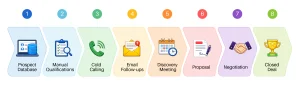
Traditional ERP sales rely on cold databases, manual prospecting, and generic outreach.
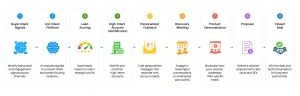
Intent-based selling focuses on organizations already showing buying signals, allowing sales teams to engage prospects more effectively.
| Traditional Sales | Intent-Based Selling |
| Large cold databases | Prioritized high-intent accounts |
| Cold calling | Warm, personalized outreach |
| Generic messaging | Personalized communication |
| Manual prospecting | AI-assisted prospecting |
| High rejection rates | Higher engagement |
| Longer qualification | Faster lead qualification |
| Reactive selling | Predictive selling |
| Lower conversion rates | Better conversion potential |
Traditional ERP Sales Process
Intent-Based ERP Sales Process
Choosing the Right Buyer Intent Platform
Understanding buyer intent is only the first step. Businesses also need technology that helps identify decision-makers, enrich prospect data, prioritize accounts, and personalize outreach.
Some platforms specialize in sales intelligence, while others focus on buyer intent, predictive analytics, or Account-Based Marketing (ABM). The right choice depends on your target audience, sales strategy, and budget. Many organizations are now integrating buyer intent signals with AI-powered account profiling and predictive scoring to improve targeting efficiency. Our blog on AI for Account-Based Marketing explores how AI can help businesses enrich ICPs, prioritize accounts, and build smarter account-based growth strategies.
Other Buyer Intent Platforms
| Platform | Best Use Case | Key Highlight |
| Bombora | Third-party buyer intent | Identifies organizations actively researching ERP, automation, and digital transformation topics across the web. |
| 6sense | AI-powered account prioritization | Combines AI, predictive analytics, buyer intent, and account scoring to identify high-intent accounts. |
| Demand base | Enterprise Account-Based Marketing (ABM) | Integrates buyer intent, advertising, website personalization, and account analytics for targeted engagement. |
| ZoomInfo | Contact discovery & CRM enrichment | Combines verified contact intelligence with buyer intent and CRM enrichment to improve prospecting. |
| LinkedIn Sales Navigator | Executive networking | Helps sales teams identify, track, and engage key decision-makers through LinkedIn insights. |
| G2 Buyer Intent | Competitor comparison insights | Tracks organizations comparing ERP vendors, helping sales teams engage buyers during the evaluation stage. |
Apollo.io
Apollo.io combines contact discovery, CRM integration, prospecting, and email automation within a single platform. It is ideal for ERP companies targeting SMBs and mid-market businesses that require affordable, high-volume outbound prospecting.
Pros
- Affordable pricing
- Large contact database
- Built-in email automation
- Easy CRM integration
- User-friendly interface
Limitations
- Basic buyer intent capabilities
- Contact accuracy varies by region
- Less suitable for enterprise ABM
Cognism
Cognism delivers enterprise-grade contact intelligence with strong international coverage, GDPR-compliant data, and enriched company insights. It is better suited for ERP vendors targeting large enterprises and global markets.
Pros
- High-quality contact data
- Strong international coverage
- Enterprise-ready platform
- GDPR-compliant database
- Ideal for complex B2B sales
Limitations
- Higher pricing
- Limited outbound automation
- Better suited for mature sales teams
Recommended Technology Stack for ERP Companies
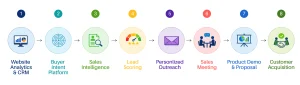
This connected ecosystem enables marketing and sales teams to identify high-intent accounts earlier, improve lead quality, prioritize outreach, and build a more predictable sales pipeline. However, technology alone cannot replace sales expertise. Buyer intent indicates potential interest, but meaningful conversations, accurate qualification, and a clear value proposition remain essential to converting prospects into customers.
The Final Takeaway:
As B2B buying journeys become more digital and complex, success is no longer defined by the volume of outreach but by engaging the right prospects at the right time. Buyer intent data, combined with sales intelligence, helps ERP providers improve ERP lead generation by identifying high-intent accounts, optimizing marketing efforts, and building a more predictable sales pipeline.
Rather than replacing traditional sales, buyer intent enhances it. By combining AI, predictive analytics, CRM, and sales intelligence, organizations can build a smarter ERP lead generation strategy that prioritizes qualified opportunities, personalizes outreach, shortens sales cycles, and improves overall conversion rates.
Ready to move beyond cold calling? Ready to transform your ERP lead generation strategy? Channel Technologies helps ERP providers strengthen ERP lead generation through buyer intent data, AI-driven insights, and data-backed demand generation strategies that connect businesses with the right buyers at the right time and help fill your sales pipeline with qualified opportunities. Get in touch with our team to build a smarter B2B sales strategy and accelerate your business growth.
FAQs:

Why is buyer intent important for ERP companies?
ERP purchases involve multiple stakeholders, longer sales cycles, and significant investment. Buyer intent data helps ERP vendors identify organizations already evaluating ERP solutions, allowing sales teams to engage prospects at the right stage of their buying journey.
Can buyer intent data replace traditional sales strategies?
No. Buyer intent is designed to enhance traditional sales efforts, not replace them. It helps sales teams prioritize high-intent accounts, personalize outreach, and make better use of their time and resources.
Which buyer intent platforms are commonly used for ERP marketing?
Popular platforms include Bombora, 6sense, Demand base, ZoomInfo, LinkedIn Sales Navigator, and G2 Buyer Intent. Each platform offers different capabilities, from buyer intent and predictive analytics to contact intelligence and account-based marketing.
How does buyer intent reduce cold calling?
Instead of contacting every company that matches your Ideal Customer Profile (ICP), buyer intent enables sales teams to focus on organizations showing active buying signals. This leads to more relevant conversations, fewer unqualified calls, and higher conversion rates.